

What is accessibility GRC software?
Accessibility GRC software is a governance, risk, and compliance system of record specialized for accessibility. It captures program activities, decisions, procurement and vendor reviews, remediation, and attestations in one place, so an organization can assign ownership, manage risk, and produce defensible evidence of compliance for regulators and auditors.
The problem AGM solves
Most organizations are doing accessibility work. Few can prove it when it matters. Findings sit in scanners, decisions sit in email, evidence sits in shared drives, and the people who remember why a call was made eventually move on. When a complaint, an audit, or a leadership question arrives, the program scrambles to reconstruct what happened. AGM is built for that moment, and for the program that prevents it. It replaces the spreadsheets of findings, the shared drives of reports, and the email threads of decisions with one governed, time-stamped record.
“Most organizations can show what they fixed. Few can demonstrate how they manage accessibility over time. That gap is what AGM closes.”
Governance, risk, and compliance for accessibility
AGM belongs to the governance, risk, and compliance category, specialized for accessibility. Governance: who owns what, which policies apply, and how decisions are made and recorded. Risk: what you are exposed to, what is aging without action, and what has been formally accepted or deferred and why. Compliance: which laws and standards apply, and whether you can demonstrate you are meeting them. If you already run enterprise GRC, AGM is the layer that does accessibility properly and stands alongside it.
Core capabilities
Program activity and event record
Structured capture of audits, reviews, training, workshops, and internal assessments.
Decision traceability
Documented rationale for prioritization, risk acceptance, deferrals, exceptions, and scope decisions.
Remediation management
Findings, named owners, status, evidence of closure, and linkage to the applicable standard.
Procurement and vendor accessibility
ACR/VPAT intake and validation, vendor evaluation, contract obligations, and ongoing vendor risk.
Attestation and reporting
Time-stamped attestation history, executive and board reporting, and regulator-facing summaries.
Program artifacts
Accessibility policy, roles and responsibilities, and program maturity.
Evidence traceability
A continuous line from evidence to issue to standard to report.
What you get
- A time-stamped program record, filterable by standard, owner, status, or date.
- Exportable evidence packages for an audit, a complaint response, or a board briefing.
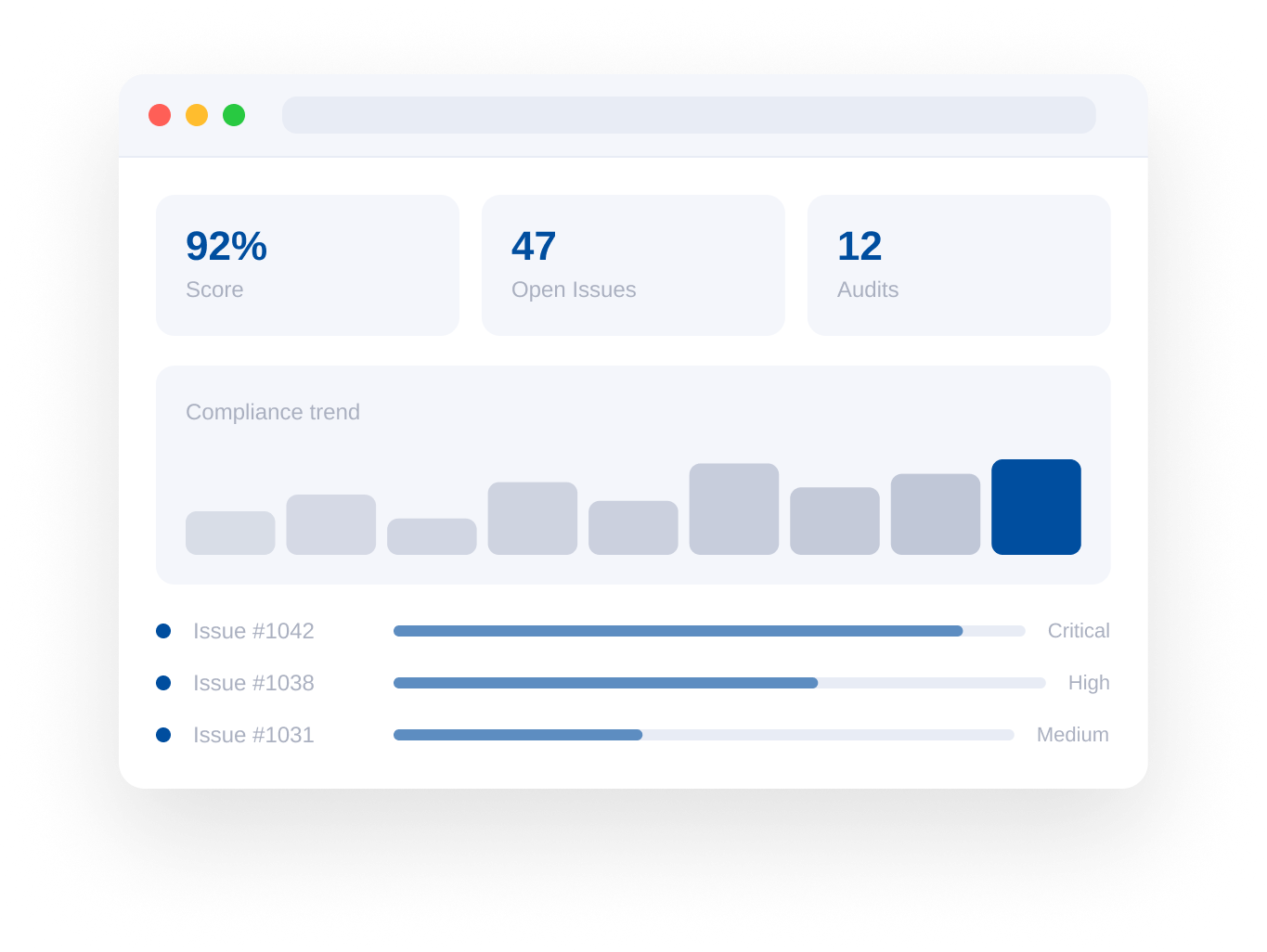
- An AGM Score and trend, with the supporting evidence one click behind it.
- ACR/VPAT generation with supporting evidence attached.
The AGM Score
AGM expresses program health as a single, evidence-based score, computed from open issues and the activity behind them. The score reflects how current your evidence is: as audits and attestations age, it decays, because evidence that is out of date no longer demonstrates a defensible program. It is a risk signal, not a vanity metric, and the full audit trail sits one click behind it.
When AGM is the right fit
You are accountable to a regulator, board, or oversight body and could be asked to demonstrate due diligence. (Government agencies, public institutions, and regulated enterprises.)
Your accessibility work is spread across teams, faculties, or systems, and no single record survives staff turnover. (Universities and college systems, airport authorities, multi-system enterprises.)
You are replacing spreadsheets and disconnected audit reports with something that holds up to scrutiny.
You procure digital products and services and need vendor accessibility governed, not filed and forgotten.
Works on its own
AGM works on its own. If you also run DocConform or ACM, their remediation outputs and monitoring findings flow into the same record automatically.
Built around your obligations
Supports evidence management for programs aligned with internationally recognized accessibility standards, including WCAG 2.2, PDF/UA, and EN 301 549, mapped to the accessibility laws that apply in your jurisdiction, such as the Accessible Canada Act and provincial acts in Canada, the ADA and Section 508 in the United States, or EN 301 549 and the European Accessibility Act in the European Union.
Aligned to WCAG 2.2, PDF/UA, and EN 301 549.
See AGM in action
We walk through a live session anchored to your regulatory context, not a generic product tour. You will see what your governance record would look like the day after a complaint or an audit request. About 45 minutes.
- Live session anchored to your regulatory context
- See what your governance record looks like after a complaint or audit request
- About 45 minutes
- A senior consultant — not a sales representative
A senior consultant, not a sales representative, will be in touch within one business day.